
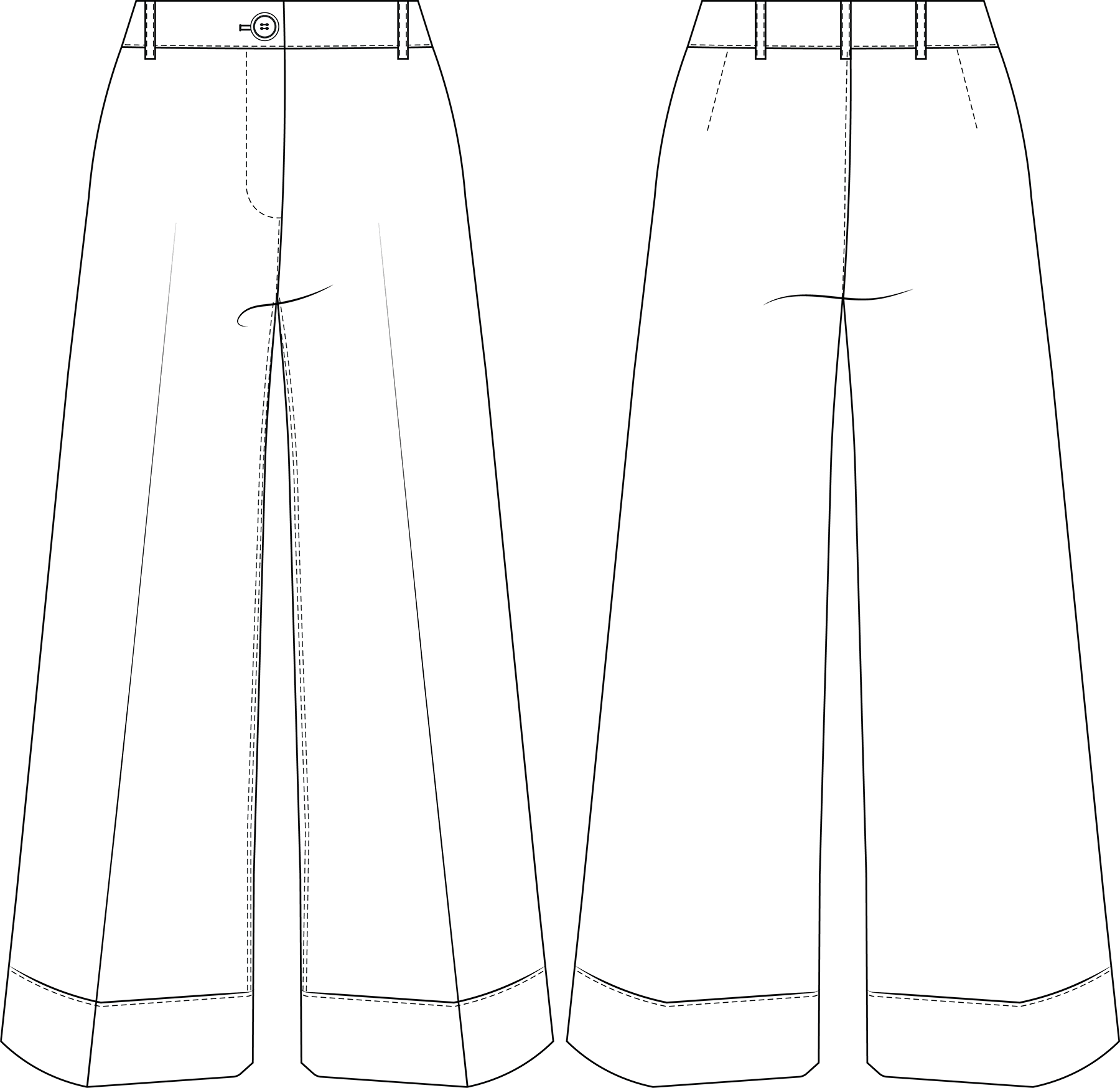
Pants are notoriously iffy when it comes to shopping for clothes online. You’ve surely experienced this yourself at least once or twice.
The reason is rather simple: too many measurements to take into account!
When measuring for pants, you have to properly calculate:
That is a lot.
Luckily, we’re here to guide you through the full process.
5 steps to accurately measure a pair of pants
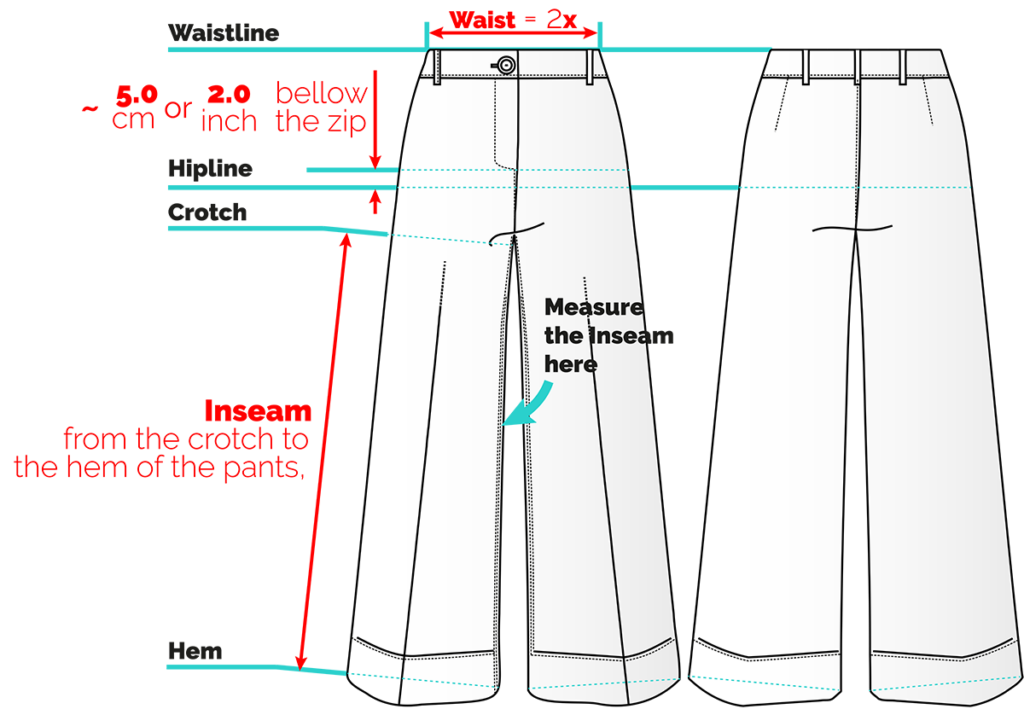
Let’s discuss every stage of the process carefully.
Step 1: How to measure the waist of pants
Starting with the waist is a good idea.
Lay the pair of pants flat. Any surface works, just make sure it’s not wobbly. The floor or a table will be fine, but a bed won’t.
The pants should be both buttoned up and zipped when you measure.
Use a soft measure tape and begin from one end of the waistband, going all the way to the opposite end. Essentially, you measure along the top edge of the waistband. Multiply this by two to get the total waist circumference.
Alternative approach: Start with one end. Then, measure along the waistband (both front and back), up until you reach your starting point. This is another way to get the waist circumference.
It’s imperative to measure the pants’ circumference in a relaxed and stretched state.
To measure the waistband of pants in their stretched state, follow these steps:
Step 2: How to measure the pants’ hip
Once again, the pants should be laid flat on a secure surface.
Identify the widest part of their hip area. Then, measure in a straight line from one end of the pants to the opposite end. Multiply this by two to get the total hip circumference of the pants.
A small tip: your hip line is usually located approximately 2 inches below the zipper.
Next, repeat what we discussed in the previous step – measuring the pants’ hipline stretched.
Measuring the stretched hipline is a straightforward process:
Step 3: How to measure the rise in pants
First, let’s elaborate:
A pair of pants has a front rise and a back rise. Generally speaking, the back rise is slightly larger than the front.
When measuring the rise, always ensure you’ve spread the pants’ legs and there are no wrinkles. Button them up properly.
For the front rise: Start by measuring from the crotch seam to the end of the waistband.
For the back rise: the same logic applies. Just turn the pants over and measure from the waistband down to where the inseams intersect at the crotch area.
Note down these measurements. Don’t be surprised if the back is larger by an inch or two, it’s normal.
Step 4: How to measure pants inseam
The inseam can be tricky.
Grab the measuring tape and start where the inner seams meet at the bottom of the crotch. Measure from this point down to the hem of the pants, keeping the tape straight.
Remember to glide along the inside of the leg!
If you have trouble, refer to our guide to measuring jeans’ inseam . The process is similar.
Step 5: Don’t forget the leg opening!
The leg opening is essential, yet many people glance over this measurement.
It’s rather easy: you just need to spread the leg opening in an even manner. Then, measure from one side to the other. Multiply this measurement by two to get the leg opening circumference.
And…You’re done!
Finding the right pair of pants:
Comparing your body measurements to pants size
Quite a few people are familiar with their body measurements but are still anxious about how to size themselves up for a pair of pants.
If you’re one of them, here’s a quick guide.
Comparing the waist
The rule to follow here is to always compare your waist measurements to pants in their stretched state.
Pants consisting of highly elastic materials can have a significant range in terms of stretch – 5.5 to 7 inches (14-18 cm). As you can guess, this is a complete transformation of the measurements you’d see with paints in a relaxed state.
Therefore, our tips here would be…
Pants made of low-elasticity fabric: The waistband should be a maximum of 0.4 inches (1 cm) larger than your waist circumference.
Pants made of elastic fabric: For the sake of comfort, your waist circumference should be equal to or smaller than the circumference of the fully stretched waistband.
Comparing the hips
Pants can be broadly divided into slim-fit or loose-fit types. Add to this the difference in material elasticity and you get some variations in the approach required.
In the case of slim-fit pants, you should pick a pair where the hip measurement in a stretched state equals or is bigger than your hips’ circumference.
With jeans featuring looser designs and/or made with less elastic materials, the scenario changes.
In this case, you want to leave a bit of ease. We recommend you add at least 0.8-1.1 inches (2-3 cm) on top of your hip measurement for a comfortable fit. Add an extra inch or two if you’re shooting for a more laid-back style.
Comparing the inseam
The inseam correlation fluctuates even more than hips, as it’s influenced by two style-specific factors:
The pants’ design and your personal fashion preferences.
Refer to our in-depth article on how to measure pants inseam (link) to get help in picking the right inseam length for you.
General advice for finding the perfect-fitting pants
We pointed out a few fundamentals earlier in this post.
Here’s a more comprehensive list if you want to be accurate in your measurements:
These would be our top five recommendations. Together, they will increase your chances of getting a pair of pants that fit you well.
Get a FREE copy of our eBook
Boost Sales For Your Fashion Brand!
A must read for every fashion designer and brand owner who wants to scale their business.
What can you do if it’s still not enough?
Unfortunately, even following all the steps and advice can prove insufficient.
The following often contribute to a pair of pants not fitting:
Measuring these factors is a nightmare for most online shoppers. In fact, quite often it’s plain impossible!
This is where SizeSense comes to help.
Our size recommendation tool considers all these extra factors to provide a 94% accurate fit. Size Sense is the most sophisticated and accurate sizing solution yet, achieving a one-to-one matching between customer measurements and the particular product they’re interested in.
For online shoppers, we ease the buying process and help them find clothing that simply fits. For merchants, we decrease return rates and abandoned carts.
Try Size Sense on the Shopify app store and join our win-win ecosystem.
Leave a Reply
You must be logged in to post a comment.